

How to Build a Strong Resume With No Experience
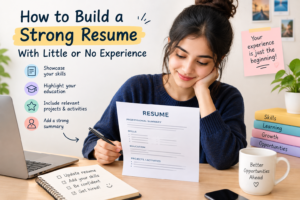

Introduction: How to Build a Strong Resume With No Experience
For many college students and fresh graduates, creating a resume can feel difficult.
One of the biggest problems is thinking, “What can I put on my resume if I don’t have any work experience?”
The good news is that you don’t need years of experience to create a strong resume. A good resume is not only about the jobs you have done. It is also about your skills, education, projects, internships, achievements, and potential.
If you are a student or fresher, your resume should show employers what you can do and why you are worth considering.
1. Start With a Clear Career Objective
A career objective is a short statement that explains what you are looking for and what you can offer.
Avoid using vague statements such as:
“I want to get a good job in a reputed company.”
Instead, make your objective specific to your skills and career goals.
For example:
“A motivated B.Com student seeking an opportunity to apply my knowledge of finance, business operations, and data analysis while developing practical professional skills.”
Keep your objective short, clear, and relevant to the position you are applying for.
2. Highlight Your Education
When you have little or no work experience, your education becomes an important part of your resume.
Include:
- Degree or course
- College or university
- Year of study or graduation
- Relevant academic achievements
- Important subjects, when relevant
For example:
Bachelor of Commerce (B.Com)
University of Lucknow
Expected graduation: 2027
You don’t need to list every subject you have studied. Focus on subjects that are relevant to the job.
3. Focus on Your Skills
Skills can make a big difference when you don’t have professional experience.
Think about what you have learned in college, through courses, projects, internships, or personal practice.
Some examples include:
- Communication
- Teamwork
- Time management
- Problem-solving
- Microsoft Excel
- Data analysis
- Digital marketing
- Presentation skills
- Professional writing
- Research
- Financial analysis
However, don’t add skills just because they sound impressive.
Only include skills that you actually have and can explain during an interview.
4. Include Internships
An internship is valuable experience, even if it was unpaid or part-time.
Instead of simply writing:
Intern – ABC Company
explain what you actually did.
For example:
Intern – Dairy Industry
- Assisted with data collection and record maintenance.
- Observed milk procurement and business operations.
- Worked with employees from different departments.
- Learned about workplace procedures and professional communication.
This helps employers understand what you learned rather than simply seeing the word “internship.”
5. Add Academic Projects
You don’t need a full-time job to have experience.
College projects can demonstrate your ability to research, analyze information, solve problems, and work with others.
You can include projects such as:
- Research projects
- Business studies
- Marketing projects
- Financial analysis
- Survey-based projects
- Group presentations
- Case studies
For each project, briefly mention what the project was about, what you did, and what you learned.
6. Add Certifications and Online Courses
Online courses can show that you are willing to learn beyond your college syllabus.
You can include certifications in areas such as:
- Advanced Excel
- Digital marketing
- Financial modelling
- Data analysis
- Communication
- Accounting
- Business management
Mention the course name, platform or organization, and completion year.
Don’t add courses you have only started unless you clearly mention that they are “In Progress.”
7. Show Your Achievements
Even small achievements can make your resume more interesting.
Think about activities where you performed well or took responsibility.
You could include:
- Academic achievements
- Competitions
- College events
- Presentations
- Certificates
- Workshops
- Leadership roles
- Volunteering
- Sports or cultural activities
For example:
“Participated in an inter-college business presentation competition.”
This gives employers more information about your interests and abilities.
8. Use Action Words
Instead of repeatedly writing phrases like “Responsible for,” use strong action words that describe what you actually did.
For example:
Instead of:
“Responsible for preparing a project report.”
Write:
“Prepared and presented a project report on consumer behaviour.”
Useful action words include:
Created, analyzed, organized, researched, prepared, managed, assisted, coordinated, presented, developed, conducted, and supported.
These words make your contributions easier to understand.
9. Keep Your Resume Simple and Professional
A strong resume does not need complicated designs or lots of colors.
Use:
- Clear headings
- Consistent fonts
- Proper spacing
- Short bullet points
- Simple formatting
- Easy-to-read sections
Avoid adding unnecessary graphics, excessive colours, emojis, or decorative elements.
Remember:
Your resume should make your information easier to understand, not harder.
10. Tailor Your Resume for Each Job
You don’t always need to send exactly the same resume to every company.
Read the job description carefully and identify the skills and qualifications the employer is looking for.
If a job requires Excel, data analysis, and communication skills, make sure your relevant experience and skills are clearly visible.
This doesn’t mean adding skills you don’t have. It means highlighting the skills that are genuinely relevant to the position.
11. Don’t Lie or Exaggerate
When you have a little or no experience, it can be tempting to make your resume sound more impressive by exaggerating your achievements.
Don’t do it.
If you write that you are an expert in Excel, an interviewer may ask you to perform an Excel task.
It is much better to honestly write:
“Intermediate knowledge of Microsoft Excel”
than to claim expertise you don’t actually have.
A strong resume should represent your real abilities.
12. Keep It Short
If you are a student or fresher, you usually don’t need a long resume.
For most beginners, one well-organized page is enough to present their education, skills, internships, projects, certifications, and achievements.
Remove information that does not help the employer understand your suitability for the position.
Your goal is not to fill the page.
Your goal is to make every section useful.
13. Proofread Before Sending
A small spelling or grammar mistake can make an otherwise good resume look careless.
Before sending your resume, check:
- Spelling
- Grammar
- Dates
- Phone number
- Email address
- Formatting
- Company and college names
- Font consistency
- Punctuation
It can also help to ask someone else to read your resume because they may notice mistakes that you missed.
A Simple Resume Structure for Freshers
If you are confused about where to start, you can follow this basic structure:
- Name and Contact Information
- Career Objective / Professional Summary
- Education
- Skills
- Internships
- Academic Projects
- Certifications / Courses
- Achievements / Activities
You don’t necessarily need every section. Choose the sections that best represent your background.
Final Thoughts
Having little or no work experience does not mean you have nothing to put on your resume.
Your education, skills, internships, projects, certifications, achievements, and willingness to learn can all demonstrate your potential.
Don’t think of your resume as a list of everything you have ever done.
Think of it as a one-page introduction that shows an employer who you are, what you can do, and why they should give you an opportunity.
You may be a fresher, but you are not without value.
You just need to present what you already have in the right way.