


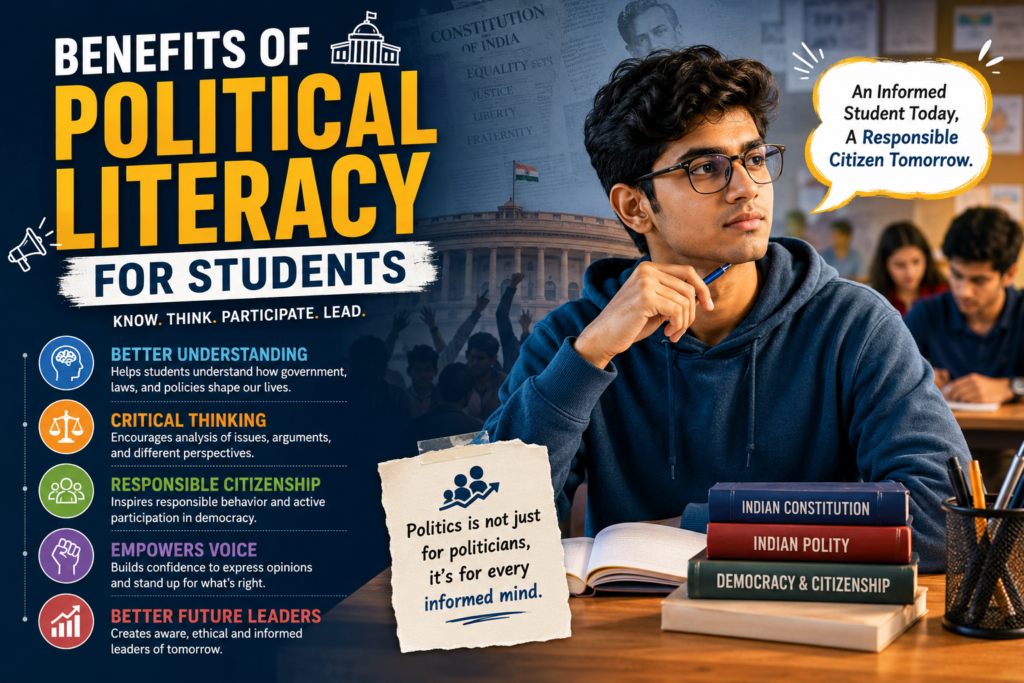

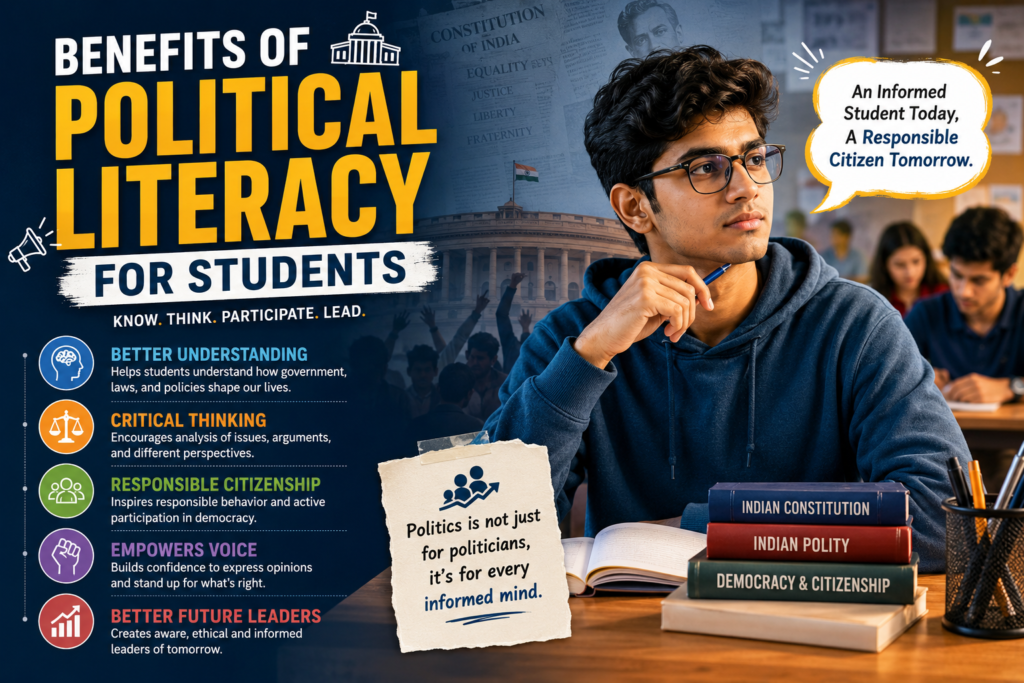
Benefits of Political Literacy for Students: Why Every Young Citizen Should Understand Politics
A few years ago, if someone mentioned politics, my first reaction was to avoid the conversation.
Like many students, I believed politics was only for politicians, election campaigns, or television debates. It felt complicated, controversial, and far removed from my daily life.
But that perspective changed when I started asking simple questions.
Why do education policies change?
Why do some laws affect students differently?
How are scholarships, exams, digital privacy, and job opportunities connected to government decisions?
The more I explored, the more I realized something important:
Political literacy isn’t about choosing sides—it’s about understanding how decisions made around us shape our everyday lives.
Today, I believe every student should develop political literacy, not to become a politician, but to become a thoughtful, informed, and responsible citizen.
What Is Political Literacy?
Political literacy is the ability to understand how governments, constitutions, elections, public institutions, laws, and public policies work.
More importantly, it helps you evaluate information critically instead of accepting every opinion you see online.
I like to call this your Civic Intelligence (CI)—the ability to understand how society functions and make informed decisions as a citizen.
Just as financial literacy helps you manage money, political literacy helps you navigate public life with confidence.
Why Political Literacy Matters More Than Ever
Today’s students live in an age where news spreads within seconds.
A viral social media post, a short video, or a trending hashtag can influence millions of people before the facts are fully verified.
Without political literacy, it’s easy to confuse opinions with evidence.
With political literacy, you become someone who asks:
- Is this information accurate?
- What is the source?
- Are different viewpoints being considered?
- What evidence supports this claim?
This habit of questioning builds stronger thinkers, not just better voters.
1. Helps You Think Critically
Political literacy teaches you to analyze issues instead of reacting emotionally.
Rather than accepting headlines at face value, you begin examining facts, comparing perspectives, and understanding the broader context.
This develops what I call Perspective Mapping—the ability to explore multiple viewpoints before forming your own opinion.
2. Makes You a Responsible Citizen
Every society depends on informed citizens.
Understanding your rights, responsibilities, and democratic processes helps you participate meaningfully in civic life.
Political literacy reminds us that citizenship isn’t limited to voting—it’s also about respecting laws, engaging respectfully with others, and contributing positively to society.
3. Improves Decision-Making
Students make decisions every day, from choosing courses to evaluating information online.
Political literacy strengthens your Decision Compass—your ability to separate reliable information from misinformation and make thoughtful choices based on evidence.
4. Strengthens Communication Skills
Political discussions require listening, explaining ideas clearly, and disagreeing respectfully.
These conversations help improve:
- Public speaking
- Debate skills
- Active listening
- Persuasive communication
- Respectful dialogue
These are valuable skills in academics, workplaces, and everyday life.
5. Helps You Recognize Misinformation
One of the biggest challenges of the digital age is information overload.
False or misleading content often spreads faster than verified information.
Political literacy encourages Source Awareness—checking where information comes from before sharing or believing it.
This simple habit can prevent the spread of misinformation.
6. Encourages Respectful Discussions
Healthy democracies depend on respectful conversations.
Political literacy teaches that people can disagree without disrespecting one another.
I call this Dialogue Intelligence—the ability to exchange ideas with curiosity rather than hostility.
Students who develop this skill often become better team members and leaders.
7. Builds Leadership Qualities
Many student leaders, club organizers, and future professionals benefit from understanding how decisions are made and how institutions function.
Political literacy nurtures:
- Responsibility
- Confidence
- Teamwork
- Problem-solving
- Ethical thinking
Leadership begins with understanding people and systems.
8. Connects Classroom Learning to Real Life
Subjects like history, economics, geography, and civics become more meaningful when you understand how they relate to current public issues.
Instead of memorizing facts for exams, you begin seeing how those ideas influence real-world decisions.
This creates Knowledge Linking—connecting academic concepts with everyday experiences.
9. Prepares You for Future Careers
Political literacy isn’t only useful for students interested in politics.
It benefits future:
- Lawyers
- Journalists
- Teachers
- Entrepreneurs
- Civil servants
- Business professionals
- Researchers
- Social workers
Understanding public institutions and policies can be valuable in many professions.
10. Helps You Become an Informed Digital Citizen
Social media has changed how people consume news.
Instead of believing every trending post, politically literate students learn to verify information, compare reliable sources, and think independently.
This develops your Digital Discernment—the habit of evaluating online information carefully before accepting or sharing it.
My Student Perspective
When I first started reading about public affairs, I expected politics to be complicated and overwhelming.
Instead, I found that understanding the basics actually reduced confusion.
Rather than following every opinion I saw online, I began asking better questions.
I stopped assuming that the loudest voice was always the most accurate.
More importantly, I became more comfortable discussing public issues respectfully with classmates who held different views.
That experience taught me something valuable:
Political literacy isn’t about always having the right answer.
It’s about learning how to ask the right questions.
How Students Can Improve Political Literacy
You don’t need to spend hours studying politics every day.
Small, consistent habits are enough.
- Read news from multiple reliable sources.
- Learn how your country’s government works.
- Understand your constitution and basic rights.
- Discuss public issues respectfully.
- Verify information before sharing it.
- Stay curious instead of becoming polarized.
Political literacy grows gradually, just like any other skill.
Frequently Asked Questions
What is political literacy?
Political literacy is the ability to understand political systems, public institutions, laws, policies, and civic responsibilities while evaluating information critically.
Why is political literacy important for students?
It helps students develop critical thinking, informed decision-making, respectful communication, and responsible citizenship.
Does political literacy mean supporting a political party?
No. Political literacy is about understanding political systems and evaluating information thoughtfully. It does not require supporting any particular party or ideology.
How can students improve political literacy?
Students can read reliable news sources, study civics, compare different viewpoints, verify information, and engage in respectful discussions about public issues.
Final Thoughts
Political literacy is one of the most valuable life skills a student can develop.
It helps you understand how society works, evaluate information more carefully, communicate respectfully, and participate responsibly in civic life.
In a world where information moves faster than ever, being politically literate doesn’t mean knowing everything.
It means staying curious, asking thoughtful questions, checking facts, and remaining open to learning.
Those habits won’t just make you a better student—they’ll help you become a more informed and responsible citizen.
Key Takeaways
- Political literacy develops your Civic Intelligence (CI).
- It strengthens critical thinking and informed decision-making.
- It improves communication and respectful dialogue.
- It helps identify misinformation through Source Awareness.
- It builds leadership and responsible citizenship.
- It connects classroom learning with real-world issues.
- It prepares students for diverse careers.
- It encourages thoughtful participation in society.